A Life Shaped by Art
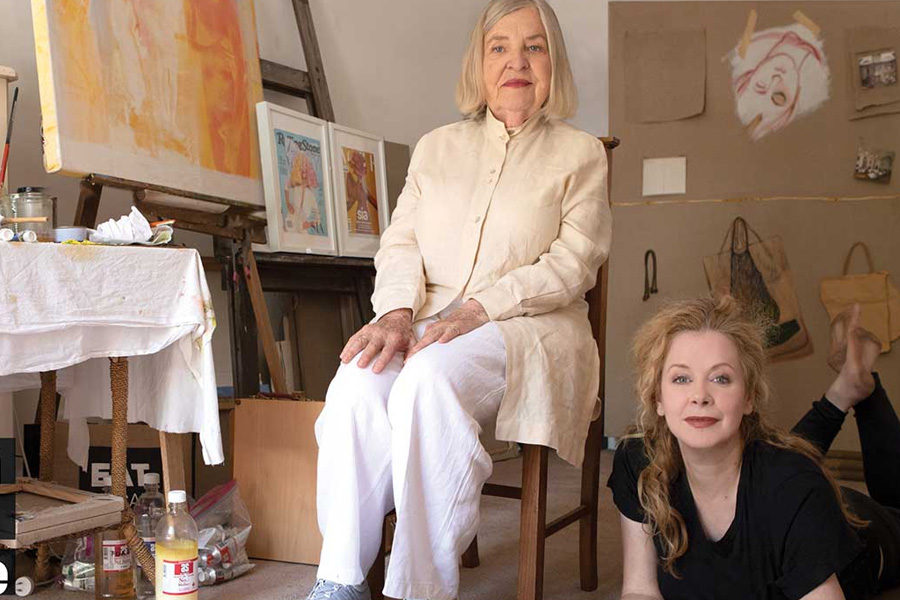
Loene Furler occupies a singular place in Australian cultural history. Born in 1944, she developed across painting, printmaking, photography, film, music, textiles, teaching, and arts leadership. That range gives her biography unusual density. She did not remain loyal to one medium for convenience. She moved through several, carrying experience from one practice into another.
Her early formation began at the South Australian School of Art, where she completed study in 1965. The following year she taught in Adelaide. That sequence already reveals momentum. She was not waiting for permission to become useful. She was teaching while still consolidating her own artistic voice.
Later in 1966, she moved to London. The relocation widened her horizon and likely sharpened her sense of artistic possibility. In 1967, she married painter Vytas Serelis there. The period reads as one of movement, encounter, and initiation. By the early 1970s, she had returned to Adelaide and pursued further study in sculpture and ceramics. That return did not indicate retreat. It marked another transformation.
Family and Creative Kinship
Loene Furler’s family circle is compact, yet each figure matters. Her husband, Vytas Serelis, was also an artist. Their marriage placed two creative temperaments within one domestic orbit. Such arrangements can be volatile, productive, or both. In Loene’s case, the relationship belonged to a formative era rather than a settled endpoint.
By the early 1970s, that marriage had ended. Even so, Serelis remains part of her story because he stands near an important shift in her life. He represents a chapter when artistic identity was still taking shape. That kind of proximity matters in biography. It helps explain the pressures and textures surrounding later work.
Phil Colson became Loene’s partner and the father of her daughter, Sia. He was also a musician and taught Loene to play bass guitar. That detail is revealing in a quiet way. It shows a relationship built upon shared learning, not only romance or parenthood. He belonged to the Adelaide music scene in the early 1970s, and that musical atmosphere clearly influenced the household.
Sia Kate Isobelle Furler, born in 1975, would later become internationally known as Sia. Her fame often dominates public attention, yet the family structure around her deserves notice. Loene’s artistic life helped create a fertile environment. The daughter did not emerge from cultural emptiness. She came from a home where art, sound, and experimentation were ordinary.
Teaching and Materials
Loene Furler’s teaching work was especially consequential. From 1982 to 1987, she taught printmaking at Indulkana and Ernabella in the Pitjanjatjara Lands. This was not ornamental service. It required adaptation, attention, and stamina. Teaching in remote communities asks an artist to listen before acting. It also demands respect for local context.
That period seems to have altered her practice substantially. Her work later incorporated textiles, fabric, self-portraiture, travel, memory, hidden forms, and organic imagery. Such an evolution feels coherent. A teacher working across place often absorbs visual languages that are not immediately visible. Pattern, surface, and repetition become more than technique. They become memory systems.
Her practice resisted confinement. Some artists polish a single style until it becomes a signature. Loene chose a less tidy route. She treated artistic material as something responsive and mobile. Sculpture, ceramics, and printmaking were not isolated compartments. They were methods within a wider appetite for discovery.
Arts Leadership and Public Influence
Loene Furler did not remain only a maker. She also became an administrator, adviser, and institutional leader. In 1989, she advised the Minister of Arts, Local Government, and State Services. That appointment reveals public trust. It also suggests that her judgment extended beyond the studio. She understood how art functioned within systems.
From 1994 to 1996, she served as CEO of JamFactory. She also led the Experimental Art Foundation, NAVA, and Craft Australia. These roles show range and authority. She was not standing at the margins of cultural life. She helped shape its infrastructure. That kind of work is often less visible than exhibition making, yet it can be more durable.
Leadership of this kind demands practical intelligence. It requires negotiation, discipline, and the ability to sustain vision under constraints. Loene appears to have done that repeatedly. Her career therefore spans both invention and stewardship. She made things, but she also built conditions in which others could make things.
Music and Domestic Rhythm
Music runs through Loene Furler’s story with unusual force. She learned bass guitar in her forties from Phil Colson. That fact matters because it shows reinvention at a later stage of life. It suggests curiosity remained active. It also suggests that domestic life was not separate from artistic development. The household became a rehearsal space for change.
Her experience in music was not incidental. She played bass and sang for many years. That activity expands the profile of a person already engaged in visual art and teaching. Her life becomes harder to summarize because it refuses disciplinary borders. That resistance is part of its interest. She was not one thing, and the record shows no desire to be reduced.
The connection between Loene’s musical life and Sia’s later career also feels significant. It is tempting to treat such continuity as destiny, but that would be lazy. Better to see it as atmosphere. Children absorb what a home normalizes. In this case, creativity appears to have been ordinary, shared, and lived rather than advertised.
Public Recognition
Recognition for Loene Furler arrived across several decades. Her work entered public collections, and she received acknowledgment for sustained contribution. In 2002, a major survey exhibition presented the breadth of her practice. That kind of exhibition usually arrives only after a body of work has achieved internal coherence. It marked her as an artist of significant depth.
In 2016, she appeared at the opening of the Sia Furler Institute. That moment carried family resonance, but it also pointed toward wider public regard. By 2022, she was honored for lifetime contribution. In 2023, she served as an art prize judge. These later moments confirm continued relevance. She remained active in public cultural life rather than receding into retrospective status.
Her presence in media, exhibitions, and arts conversations through 2024 and 2025 shows persistence. Longevity in art is never just about survival. It depends on continued exchange with present conditions. Loene Furler appears to have maintained that exchange.
Timeline
| Year | Event |
|---|---|
| 1944 | Born in Australia |
| 1965 | Completed studies at the South Australian School of Art |
| 1966 | Taught in Adelaide and moved to London |
| 1967 | Married Vytas Serelis |
| Early 1970s | Returned to Adelaide and studied sculpture and ceramics |
| 1975 | Sia Furler was born |
| 1982 to 1987 | Taught printmaking in the Pitjanjatjara Lands |
| 1989 | Advised the Minister for the Arts |
| 1994 to 1996 | Served as CEO of JamFactory |
| 2002 | Major survey exhibition of her work |
| 2016 | Appeared at the opening of the Sia Furler Institute |
| 2022 | Honored for lifetime contribution |
| 2023 | Served as an art prize judge |
| 2024 to 2025 | Continued appearing in arts media and exhibitions |
Key Takeaways
Loene Furler is best understood as a multidimensional Australian artist and cultural leader. Her career moved across media, including painting, printmaking, textiles, sculpture, ceramics, music, and teaching. She studied at the South Australian School of Art, lived in London, and later returned to Adelaide for further training. Her teaching work in the Pitjanjatjara Lands was central to her development and expanded her artistic vocabulary. Her leadership roles at JamFactory, NAVA, Craft Australia, and other institutions show substantial public influence. Her family life included painter Vytas Serelis, musician Phil Colson, and daughter Sia, whose career brought the family wider recognition.